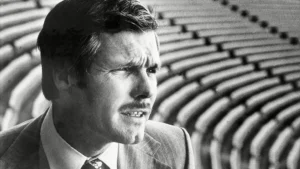
 As most of the western world knows, Atlanta born-and-raised Ted Turner, the legendary self-made media mogul, Renaissance man, and balls-to-the-wall, hell-raising maverick, passed away a few days ago. And while there are any number of accounts out there lauding his many accomplishments in life – everything from launching CNN, completely re-imagining the news cycle, and rescuing the vast MGM film library from some combination of obscurity and physical decay to, somehow, winning the prestigious America’s Cup sailboat race – what follows only softly brushes up against such headline-making achievements.
Instead, what you're about to read is a reflection of how, a lifetime ago, I crossed paths a handful of times with Mr. Turner and did so in the unlikeliest of ways. Yet, in the process of those few encounters, I developed an appreciation, even fondness for the man in ways that, years prior, I’d have never imagined possible.
Let’s go back to 1978. I’m a recent college grad working as a full-time bartender in a downtown Syracuse hotel, and a young stallion not so much burning the candle at both ends as throwing the entire thing into the incinerator and slamming the door shut. It was, I remember, a Thursday morning, maybe 4:00 AM, and I’d been up all night. I was sitting in my recliner and, between sips and tokes, reading the most recent issue of the Sporting News, my weekly bible of all-things-baseball that had just arrived.
It was a scene in which yours truly, if he’d ever found his life magically projected onto a silver screen, might have been played by a young, brash, and terminally wisecracking Bill Murray – he, of the Stripes vintage.
 I was, in other words, a kid long on promise and attitude and stunningly short on deliverables – a rutting buck believing himself bulletproof and teeming with a certain something that for years could always be counted on to straddle the fine line between charm and smarm, a kid who embodied every square inch of the concept, “rudderless.”
At one point, I took one final toke, put down my magazine, looked at the blank wall just ahead of me, and exhaled. That’s when I looked up and said to no one in particular, "I gotta do something with my life.”
And that, I suppose, was the beginning.
Because the very next day I woke up at the crack of noon, called directory assistance for the phone number of the Atlanta Braves, and told the person to whom I'd been directed that if Mr. Turner would agree to interview me for a job, I’d walk to the interview from my home in Syracuse.
I’ll never forget the response of that still nameless voice on the other end of the line. After what sure seemed like ten minutes, but was likely only two or three seconds, he said simply, “OK.”
Forget the naiveté of asking for an entry level interview with the owner of the whole damn team, it was an offer made in earnest and done so with the purest of intentions.
And that was it. Next thing I knew, I’d quit my bartending gig and had called a – get this – press conference at the Hotel Syracuse to announce my plans to walk 900 miles for my very first real-life job interview, one with the new madman owner of my favorite team.
Let’s fast forward here.
I’ll spare you the gory details of the walk itself (that is, indeed, a story for another time), but what’s important to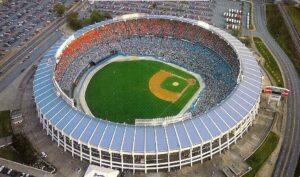 keep in mind in the context of this tale is that, on my walk, each time I’d make it to yet another town that had either a weekly newspaper or, in a few cases, a daily one, I’d leave the reporter who interviewed me two stamped and pre-addressed envelopes, both in hot pink (so as to get noticed).
One was addressed to my parents, who were busy assembling a scrapbook.
The second was addressed to Turner, in care of his team. The goal, I suppose, was to make the man aware of my ability to gin up media interest in a story that I, myself, had concocted.
That’s also to say that, for better or worse, Ted knew I was coming and that, little by little, I was getting closer each day.
But, again, in the interest of skipping ahead, when I got to Atlanta Fulton County Stadium, it was a rainy and unusually chilly day (especially for April). There was no one from the Braves outside to greet me and, indeed, I had to wait in the reception area for what felt like an hour until some low level gofer came out to usher me back into the general offices.
It was not, certainly, what I’d been expecting, much less hoping for. And it was, as well, a Thursday, as I recall – the day before the 1979 baseball season kicked off and the Braves opened at home against the Astros of Houston.
I was told by the club's PR director that, while the Braves couldn’t offer me a front office job, management would give me every opportunity to prove my mettle as a member of their grounds crew – meaning they’d be willing to pay me minimum wage (roughly $2 an hour at the time) to work maybe six hours a day for a total of 81 home games. That's it.
I was told in no uncertain terms, however, that I'd not be interviewed by Mr. Turner.
“But that wasn’t our deal,” I gently protested.
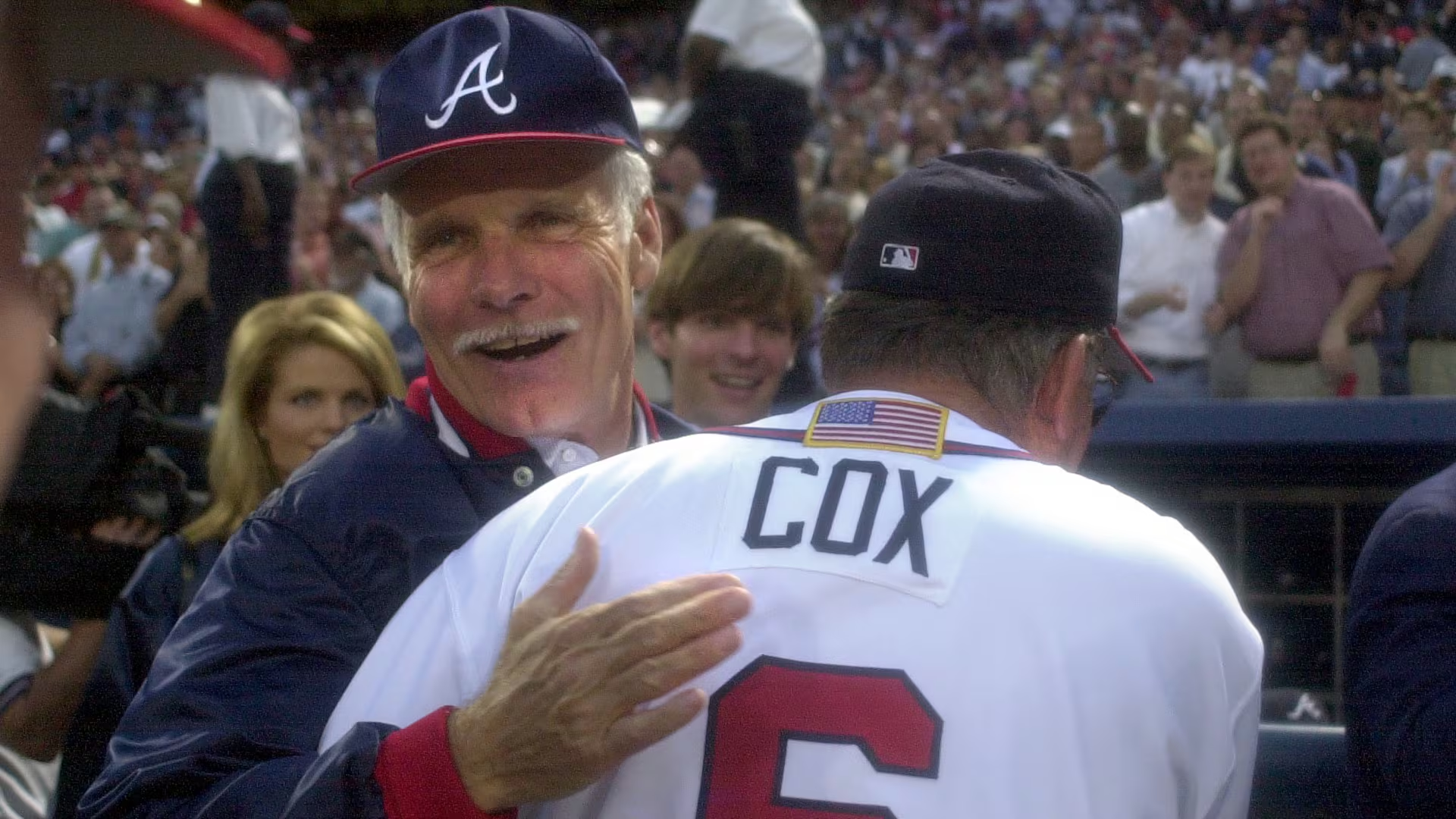 Regardless, I was dismissed out of hand by the guy and instructed that I’d be introduced to the media at a press conference they had scheduled for the noon hour, one during which Mr. Turner and manager Bobby Cox would be discussing the state of the team.
To say I was crestfallen wouldn’t begin to scratch the surface of my sense of betrayal. Regardless, I asked for directions and dutifully began working my way toward the Stadium Club, a bar/restaurant area in the ballpark, where I’d then bide my time waiting for said press conference.
I remember sitting there with my thoughts, alone at the end of the bar, wondering what the hell just happened. After walking for 50 days straight, and walking alone for miles through all kinds of weather, everything from frigid cold and biting wind to pelting rain, I was almost numb with disbelief. Certainly, I’d never treat someone that way I was being treated now. I just wasn’t brought up that way.
Sure enough, little by little, folks began to filter in, and before long there were maybe 75 people crowded around the once-empty Stadium Club bar, most of them ordering a soft drink. It was, after all, not yet noon.
Then, at one point, every head in the place began turning in one direction and I started to hear a low murmur. There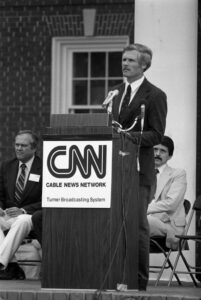 in the doorway stood a man significantly taller than I’d imagined. It was Ted who, if nothing else, possessed a clear and almost regal sense of presence.
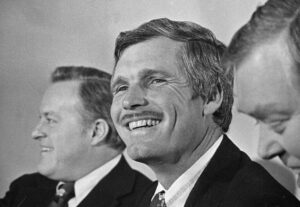
Just like virtually every other businessman in the "New South" of 1979, the Braves' owner was clad in the uniform of his place and time: navy blue blazer, grey flannel pants, white cotton buttoned down shirt, and a yellow silk neckpiece that for a number of years used to be called a power tie.
I, on the other hand, a 23-year-old job-seeking knucklehead, was wearing the same worn-out clothes I’d been sporting for nearly two months: faded jeans, tee shirt, open collar flannel shirt and a beat up old baseball cap. In other words, especially in that sea of business sameness, lock-step thinking, and implied-but-ultimately imagined power, I stuck out like the proverbial sore thumb.
Ted eventually approached the bar and immediately drawled loudly above the din to the bartender to give him a vodka. However, even as he made his way through the crowd, and even before he reached the bar, he blurted out something that completely caught me off guard.
As some reading this might know, my last name's pronounced very much like the word “until,” only with an “A," and with an emphasis equally on both syllables. But that’s not what stopped me or made my heart momentarily sink in my chest.
It was when Ted, even as one of his minions handed him his drink, blurted out in his trademark drawl – a raspy mash up that, in his case, occupied the vast divide between the sound of a normal speaking voice and full-on yelling – “WHERE’S ANT HILL?"
Then, the Braves' owner didn’t so much laugh, as cackle. And being that many in the room likely worked for him, a number of those on hand did much the same thing, laughing at me right along with their boss.
What’s more, rather than look my way (I was at the far end of the bar, to Turner's right, maybe thirty or so feet from him) the Braves' owner took a big swig and kept looking straight ahead into the mirrored wall that ran behind the length of the bar.
“I’m, uh, I’m down here, Mr. Turner,” I replied, slowly raising my hand with a level of uncertainty and sheepishness that, to be fair, I’d never really known in my life.
SO, YOU WALKED ALL THE WAY DOWN HERE FROM NEW YORK, HUH?” Turner bellowed in that southern bark-talk tone of his. He then snapped, “HOW’S YOUR FEET?” still refusing to look at me.
“Not bad,” I offered, somewhat steadier now, “given that I just walked a thousand miles.”
He wouldn’t let go, though, and kept digging. “WHERE Y’ALL SLEEPIN’ TONIGHT?”
“I really don’t know. I just got into town.”
It was then that I realized that every last head in the room was now ping-ponging back and forth between the two of us, not unlike the crowd at a tennis match, each head pivoting left then right in anticipation of what came next – a realization that only added to my heightened level of anxiety.
“WELL, I’LL TELL YA WHAT – ANT HILL,” he chirped, this time stretching out his caustic mispronunciation of my last name as though trying to rub my nose in it, “SINCE YOU’RE SUCH A BIG BASEBALL FAN, WHY DON’T YOU SLEEP BY HOME PLATE TONIGHT?”
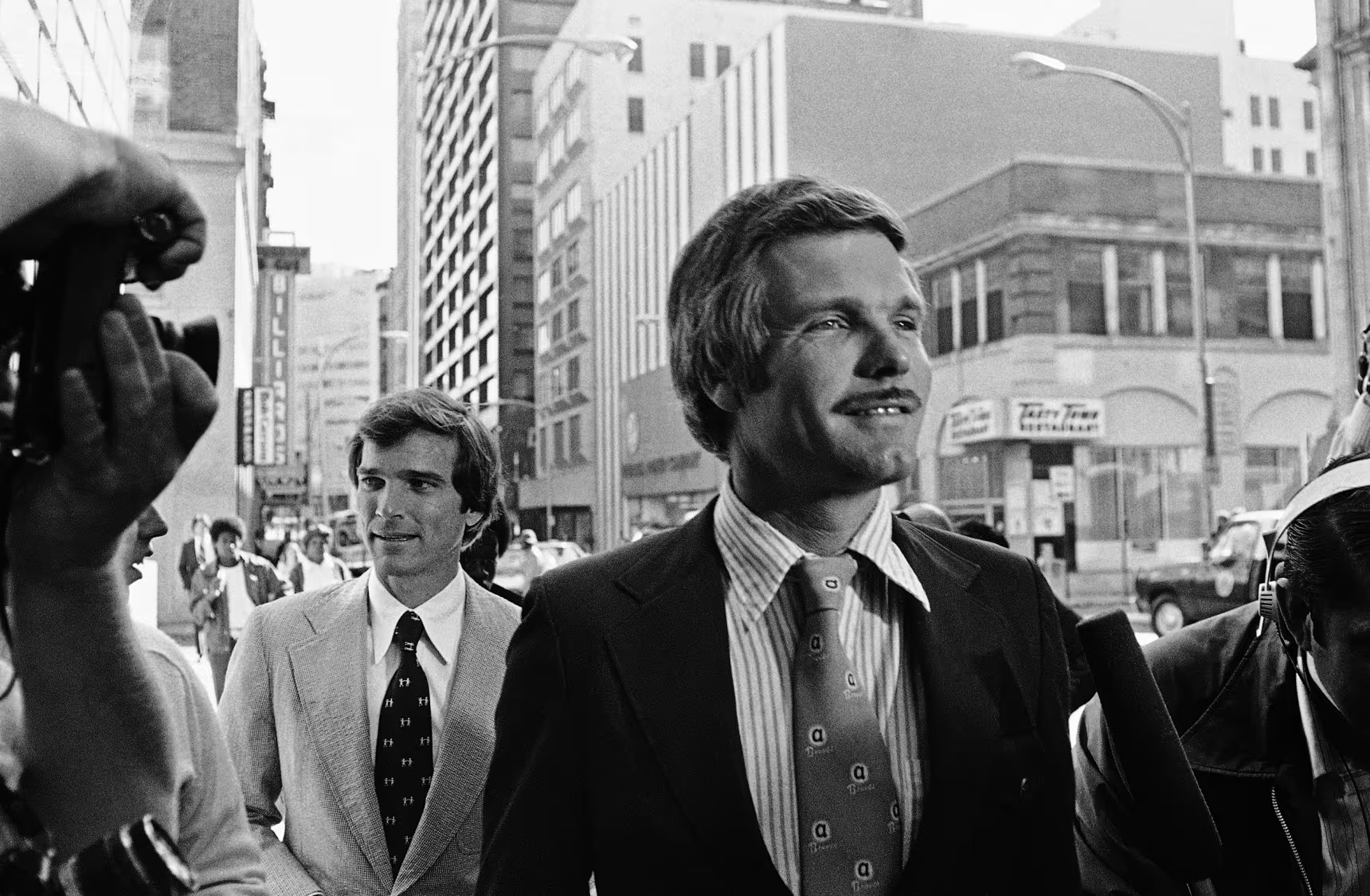 He then laughed at his own cruel joke, and did so in a way that not only echoed his cackle of a few seconds ago, but made me, standing alone in a crowd of strangers at the far end of the bar, feel like the human equivalent of something he’d just stepped in.
And, of course, much of the room quickly followed their boss’s lead and let me know just how much (or little) they all thought of me and my walk, laughing loudly – this despite what I’d just done in the name of the very team they all worked for.
I, of course, never did go to work for Ted Turner or the Braves. But, again, that’s another story for another time.
That said, at this point let’s again jump forward. It’s now a dozen or so years later. Ted has since launched CNN, TNT, and TCM. He's also yet to sell his company, Turner Broadcasting, to Warner Bros. And while he still owns the Braves, they’re now little more than an afterthought to him. His mind is now fixed squarely on gaining distribution for his growing family of TV networks – and that means making deeper inroads in the still-fledgling cable industry and strengthening his ties there.
Meanwhile, I'm working for one of the Newhouse cable television properties. It’s the Western Cable Show, a major industry convention held late each year in Anaheim. The show's something of a magnet, attracting thousands of operators from just about every point west of the Mississippi, including some of the most headstrong, independent thinkers in the land. It is, I'm guessing, 1990 or ’91.
On the floor of the exhibit hall one day, I’m walking by the sprawling Turner Broadcasting booth. There, standing with a few of his senior affiliate reps, I see Ted. For reasons I still don’t fully understand, I made a left turn and walked straight up to the crowd of employees gathered around their boss, two of whom I knew.
After some brief small talk, I approached and stuck out my hand. “Ted,” I said, “M.C. Antil.”
He looked at me for a moment, cocked his head knowingly, and said with something of a half-smile, “Yeah, I know you. You work for Bobby Miron, right?” referencing my boss.
“I do,” I said.
“Give him my best. I like Bobby. He’s a good guy.”
“I will,” I said almost dismissively, before quickly adding, “Hey, Ted, can I tell you a story?”
I then proceeded to relate to him a truncated version of our first encounter, the one in Atlanta a decade or so prior.
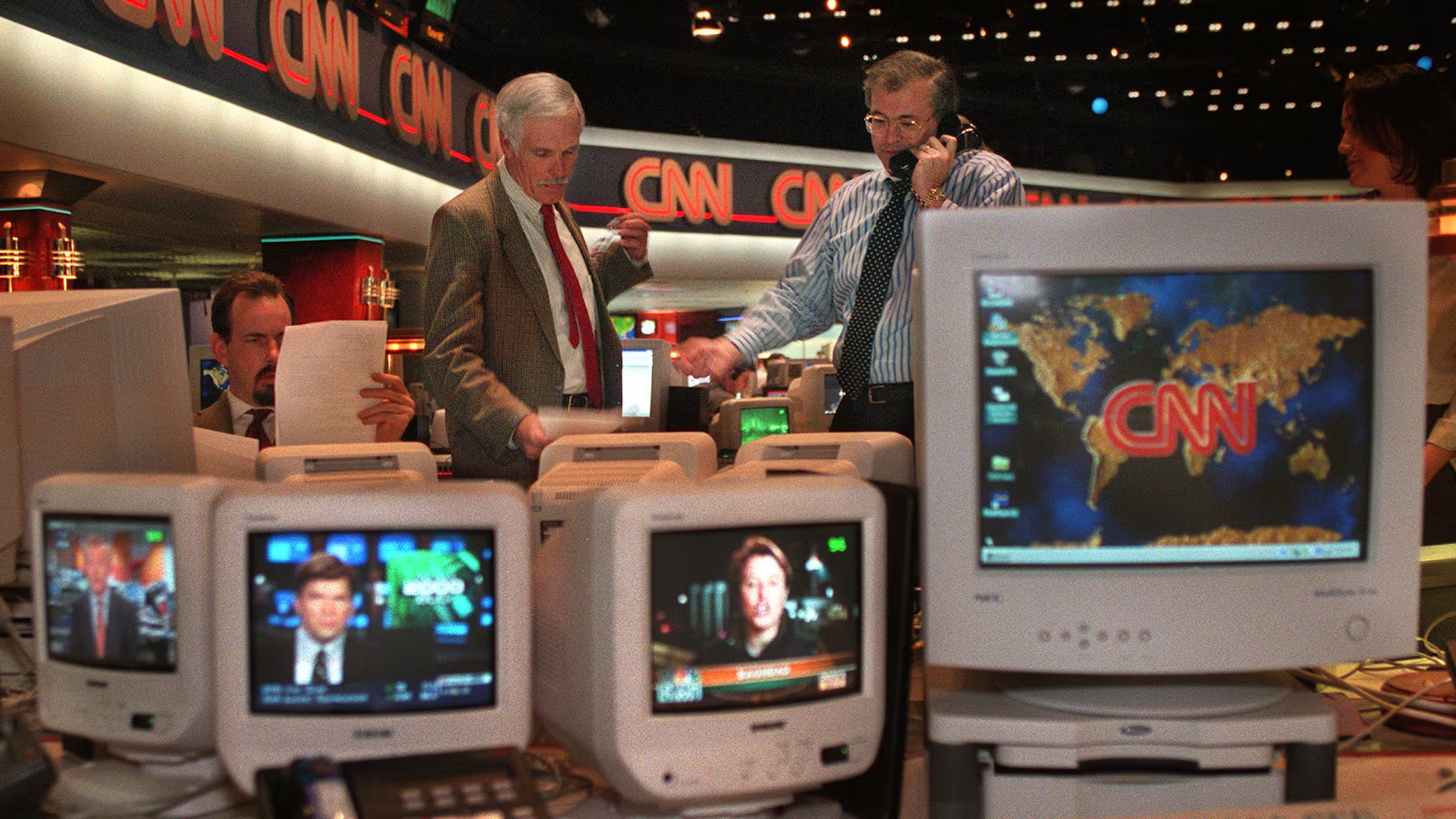 He looked at me, hesitated, and then asked, “Wait. You did what?”
I cut him off and frowned. “Oh, c’mon. Stop. Don’t give me that bullsh*t. Don’t tell me you don’t remember when a guy walks a thousand miles for a job interview with you. That's just not the sort of thing a man tends to forget.”
He looked at me for another moment before finally confessing (in a far less Ted-like tone). “Yeah, well, I seem to recall something like that,” before adding, his face suddenly looking as though he'd just experienced a flash of divine insight, “Well, why the hell didn’t ya try to get a job in cable?”
I said, “Because back then there was no cable.”
“Oh yeah,” he darkened and drawled sheepishly, now even softer than before.
Then, looking at me in a way I’ll never forget, he asked directly, “Let me get this straight. You walked all the way from New York to Atlanta for a job interview with me?”
I said, “Yeah.”
“And I treated you like that?”
“Yeah.”
And this is the part that still hits me where I live.
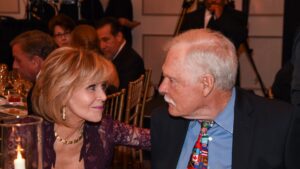 It was then that I first saw a glimpse of Ted Turner, not as a maverick or storied media tycoon, and not as some larger-than-life cartoon character who served as a walking sound byte for anyone with a microphone or notepad, but as a fellow human being. I saw him as a normal guy with normal, everyday flaws, one whose colorful past would constantly keep popping up at the most unexpected times, and in the unlikeliest of places – a past still, somehow, simultaneously deifying and dogging him.
By many accounts, a few of which were related to me by friends who knew the guy, by the end of 1990, Ted had become a more clear-eyed, clear-minded and empathetic man than he’d ever been. He also just might have been in treatment for any number of mental health issues and chemical imbalances – all of which had, possibly, been a part of his makeup for years.
The owner of my favorite team and the most vitally important individual my industry would ever know, just looked me in the eye, shrugged, and said without even a wisp of uncertainty, “Well, sh*t. I’m sorry.”
For years, I used to tell folks that my walk to Atlanta might not have gotten me the job I wanted. But it earned me something rarer and far more elusive. It got me something that few people anywhere, living or dead, could ever say they got from Ted Turner.
An apology.
But that largely dismissive distillation of the stunt I’d once pulled to try to land my first big-boy job soon gave way to a deeper and more profound understanding of the man at the very center of it.
Because years later, especially as I watched folks around me continue to compromise themselves in some toxic mix of money, fame, security, convenience and, for lack of a better description, a path of the least possible resistance, I began viewing Ted Turner in a different, far more forgiving light.
I slowly but surely began seeing Ted no longer as the “Mouth of the South” or the brash blowhard once billed as being “cable when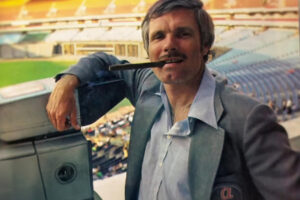 cable wasn’t cool,” but as a man of deep principle and a steely mix of spine, guts, and fortitude, one whose sense of who he was, what he stood for, and what he believed in was matched only by his relentless courage in the pursuit of staying true to those things.
For example, following the end of his whirlwind, high-profile marriage to actress Jane Fonda, when he moved alone up to rural Montana (a state that I too have recently gotten to know and love) and started buying up thousands of square miles of raw and mostly untouched prairie land, it was thought by many that he was, yet again, simply being a shrewd and forward-thinking business speculator. I had, for example, more than a few old cable cronies tell me what Ted was doing in Montana was not so much about buying what was above the ground, but buying what ran beneath it. It was, they contended, the CNN founder gobbling up as much in the way of water rights as he could in a part of the country that was soon going to be in desperate need of the stuff. “Ted’s likely gonna make billions with all those underground water rights he's acquiring,” they’d tell me.
“He doesn’t care about conservation or ranching,” they’d say. “He’s just being his typically brilliant self. That’s why he’s up there gobbling up so much contiguous land out in the middle of nowhere.”
But you know what? Those people were wrong then. And they're still wrong now. Because, as it turns out, Ted Turner might have really liked business and constantly proving all his naysayers wrong, but what he loved – and I mean truly loved, especially late in life – was nature. And he loved the land that God had blessed him with – in fact, blessed us all with – the same bountiful and beautiful little planet that that very same God had hoped someday those in positions of power and influence, people exactly like Ted Turner, would protect and defend with every ounce of whatever power and wealth they'd been able to accumulate.
And that’s exactly what Ted did for the remainder of his days.
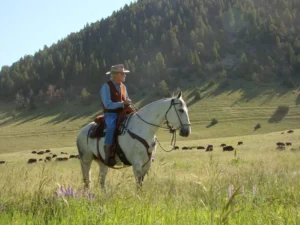 And in doing that, he’d emerge as one of the most profoundly impactful conservationists in human history, eventually buying and designating as “forever wild” some two million pristine acres in places like Argentina and the American West.
In addition, he’d oversee a massive reintroduction of the American bison into its native habitat, eventually building a herd of “genetically pure” bison of nearly 50,000 head – the largest such herd in the world – an accomplishment that landed him, as one might expect, in the American Bison Hall of Fame.
That said, now that he’s gone, there are three things that I’ll always think of whenever I call to mind the remarkable dreamer and doer who changed his world like few others, before or since.
First, much like (I’m guessing) John D. Rockefeller, Andrew Carnegie, Warren Buffet, and Bill Gates, he’ll be forever remembered for all he accomplished in the world of business. Yet, just like those other men, the thing about which he was likely the proudest – especially near the end of his run – was the extent to which he made the very world that helped shape him a richer, healthier, and far more textured place, especially once he began using his billions to change the very arc of Mother Earth's fate and future.
Second – and this one is one that truly strikes home for yours truly, a lifelong accidental bachelor – you want to know the true measure of any man? Ask his former lovers about him, and listen to the deep affection that pours from between the lines of just about everything they have to tell you about him. To that end, I urge you to read Jane Fonda’s recent essay on Ted, the man she – after six decades worth of marriage to men of profound fame, money, and power – now regularly calls her “favorite ex-husband.”
But, mostly, think of how often in your own life you might have done something completely differently had, back then, you only had the courage of your convictions.
That was Ted Turner, a great businessman, yes. But also – warts and all – just maybe, the single most principled and fearless son of a gun I've was ever lucky enough to meet.
Godspeed, Ted.
And from all of us who were paying attention from afar all these years – especially that one crazy Yankee, the brash, snot-nosed kid from Central New York you once treated like something you’d just stepped in – thanks for the courage you always displayed, the extent to which you always refused to compromise your principles, and, especially, just how fearlessly you always chose the road less traveled.