There are two things I wanted to write about the moment I heard the news, but one of the two – the deaths a few weeks ago of two of my earliest musical heroes, Brian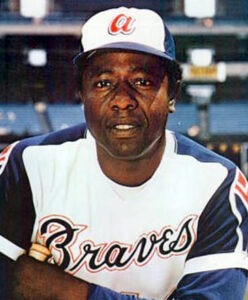 Wilson and Sly Stone – will have to wait at least a few more days. That's because there’s something far more pressing that needs my attention and something that this morning has compelled me to finally roll up my sleeves and commit my thoughts to the page you're reading now.
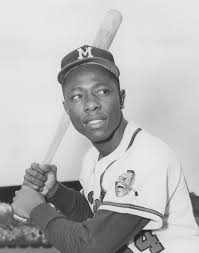
The event was the celebration at this year’s MLB All Star game in Atlanta, commemorating the moment Hank Aaron (ironically, my biggest boyhood hero) broke Babe Ruth’s career home run mark by blasting his 715th on a warm Spring night in Georgia.
But first we have to go back to that very night – April 8, 1974. I was a sophomore in college, a tiny liberal arts school in Upstate New York. I was living on campus in one of its dorms. And, given that my roommate and I had no television of our own, I decided to wander down the hall in search of an open door and, hopefully, someone inside who (a) owned a TV and (b) had the thing tuned to the NBC broadcast of the Braves/Dodgers game.
One of the two guys whose room I found, was a junior named Charlie. And while I knew Charlie some, it turns out I didn’t know him very well at all.
Anyway, soon after entering Charlie's room and settling in, I started to wax on and on about my long-standing geekiness for Hank Aaron, including the extent to which my devotion had once manifest itself (a full-size poster of Aaron over my bed as a kid, the idea that I'd once taken a magic marker and drawn a second four on the back of my Little League jersey, transforming its #4 to #44 – his uniform number – and the fact that for a few years, anyway, I used to send a birthday card to my boyhood hero in care of his employer, the Braves).
As I was talking, Charlie looked at me as though I had carrots growing out of my ears. “Seriously, M.C.?” he asked, “You want that f***in’ n***er to break Babe Ruth’s record???”
Part of me wanted, of course, to just get up and leave. I’d certainly heard such language (and similar sentiments) before, but it was usually from people my parents age, or older. Not mine. My generation, or so I wanted to believe, was more enlightened. So, I bit my lip, said nothing, and let it go. I didn’t want to make a scene. After all, I was a guest in his room. Besides, I was bound and determined to watch the Braves that night, convinced that my hero was on the verge of doing the unimaginable, breaking the single most revered record in sports – and I was not going to miss it for anything in the world.
 Now, a quick aside. The subsequent years have taught me there are two types of racism in this world – especially among many my age, both black and white: a blind, sort of hate-filled racism, along with a phenomenon that (for lack of a better description) I'll call cultural racism.
The former is a toxic, highly acidic form of racism, a hatred based in neither logic or fact, and one that invariably eats away at the soul of the hater – often making him or her ugly, bitter and, in the end, lonely.
But the latter is not hate-based at all. It's a racism that's both taught and learned at an early age, and one often handed down from one generation to the next – not unlike, I suppose, an inherited disease.
What I’ll never forget that night, though, and what I still think about to this day, is this: when Aaron took an Al Downing pitch deep into the Georgia night for his record-setting blast (his "home run for the ages," if you will) not only did I jump out of my seat and scream like a banshee, but so did Charlie. In fact, if memory serves (and if humanly possible) he might have been more excited than I. At one point, he even ran over and gave me a big bear hug, while jumping up and down and screaming at the top of his lungs, “Holy sh*t, M.C.! The f***in’ n***er did it!!!” He then, as I recall, started running up and down the dorm's hallway, cheering and pumping both fists, while repeating that final particularly vile proclamation as he did.
Fast forward 51 years. The Major League Baseball All Star game has come to Atlanta, the site of a HR that once echoed across the land. I can only assume some mix of Braves’ staffers and minions from the commissioner’s office has pieced together (or managed the process of piecing together) an all-digital tribute to Aaron’s moment for the ages, a hologram, pyrotechnic, and audio-based marvel, complete with blaring high-quality speakers – one that subsequently plays itself out in the middle of the game’s 6th inning.
I'm not watching since – though I remain a huge fan of the game of baseball – I stand firm in my belief that Bud Selig and his interleague play idea, an idea that someday the man will take to the grave with him, conspired to destroy the very thing that once made MLB’s annual All Star affair so "un-missable" – namely a chance to witness the only time each season when the best players from baseball's two major leagues would square off and face each other, and do so in a contest that, to many of them, was just as important as the World Series.
So, as I said, I wasn’t watching the All Star game and didn’t care to see the Aaron tribute live. I’d watch the latter of those two things, I figured, later on YouTube.
Now, one more sidebar.
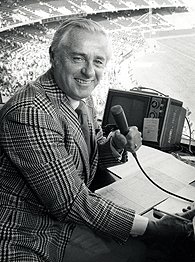 On that April night in 1974, since NBC was carrying the game nationally, all most of us got to hear was the home run call of a ubiquitous but largely garden-variety announcer named Curt Gowdy. Gowdy was nothing more than a workmanlike play-by-play man with limited language skills and a sense of timing that could be downright plodding. It wasn’t until weeks and even months later, as the film clip of Aaron’s 715th kept getting repeated over and over on national TV, that the world got to hear the call of the hometown voice of the Braves, a real pro named Milo Hamilton.
Hamilton’s home run call was vastly superior to Gowdy's – though, in fairness, it rankled more than a few many years later when it was revealed that his historic inning should have, rightfully, gone to his broadcast partner at the time, Ernie Johnson, Sr – one of the truly nicest men you'd ever hope to meet. But Hamilton, apparently, pulled rank and demanded that he, not Johnson, be behind the mic each time Aaron came to bat with a chance to break Ruth's record. Regardless, it was a great call, and soon Curt Gowdy’s milquetoast rendering of the moment had become little more than an historical footnote.
However, it wasn’t until decades later that a third home run call emerged, a call by one by the finest play-by-play man the game has ever known – and ever will know – the immortal Vin Scully, who happened to be doing the Braves/Dodgers tilt that night for the latter's radio network.
Scully, you see, was more than just a baseball announcer – infinitely more, in fact. He was Shakespeare, Cole Porter, Billy Wilder, James Thurber, and Jean Shepherd, all rolled into one. His words carried with them the unmistakable whiff of poetry, and his voice was as lyrical as it was melodic. As a result, his calls, one would swear – especially the biggest and most historic of them – almost sounded as though they’d been painstakingly pieced together by a whole team of writers.
Plus, he was an absolutely marvelous storyteller (And, indeed, I use the word "marvelous" here in direct tribute to him, because it was one of those handful of words that rolled off the Dodger announcer's tongue like no one else's).
But Vinnie worked alone. Always. In fact, once the Dodgers left Brooklyn for Southern California, and once his singular brand of genius became common knowledge, especially among his bosses, he never again had to partner with anyone in the booth. And time after time behind the mic, Scully would constantly rise to the moment during a L.A. Dodger game – wherever that game was played, and whenever that moment happened to occur.
One of his most remarkable calls was the night Sandy Koufax pitched his fourth and final no-hitter, this one a perfect game. Scully set the stage that evening in a manner that, frankly, would have made even the greatest writers in American history proud, everyone from William Faulkner to Dashiell Hammett. The last batter Koufax faced in the top of the 9th inning was an aging, but still-tough former batting champ named Harvey Kuenn, then of Chicago's Cubs.
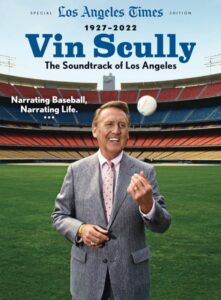 Before the strike to secure the game’s 27th and final out, Scully told his listeners, each one of whom was now, one would think, sitting on the edge of his or her seat, “It is 9:46 PM. (pause) Two and two to Harvey Kuenn. (pause) One strike away…”
Then, as Kuenn swung and missed Koufax’s final offering, after calling the strikeout, rather than barking out a series of tired old sports cliches to support the moment, Scully simply drew a breath, exhaled, and, in his trademark fashion, repeated the beginning of that very same line over the now-thunderous roar of the crowd, only this time adding a flourish that took what had been an otherwise indelible baseball moment and turned it into something timeless, if not something for the ages: “On the scoreboard in right field, it is 9:46 PM in the City of the Angels, Los Angeles, California, and a crowd of 29,139 has tuned in…, ending his little sliver of impromptu poetry with a riff on the spelling of the Dodger left hander's last name, given it started with a K and the fact he'd just ended his perfect game by striking out the last six batter he'd faced.”
Never before in the history of broadcasting had any team’s hometown announcer risen to the occasion to such an extent – while also managing to narrate history even as he was participating in it.
But back to Atlanta and 1974.
That entire offseason, Henry Aaron had been bombarded with hate mail and death threats. What’s more, a number of them were deemed so credible that the Braves eventually hired two full time members of the Atlanta PD to guard their star slugger around the clock, while the local field office of the FBI urged Aaron not to play that night in fear for his safety. It was, indeed, an ugly time in America – made all the uglier as the media began to catch wind of (and report on) the nature and volume of the most venomous mail Aaron was receiving.
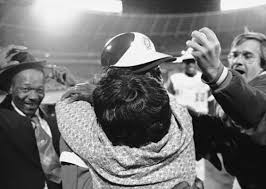
There were plenty of people in the South and beyond who simply had no desire to see a Black man out-homer their beloved Babe. In fact, later, when Aaron’s mother met him at home plate after he circled the bases, she immediately threw her arms around her son. Later, when asked about it, she explained that, more than celebrating, she wanted to serve as a shield to protect her boy, in case someone tried to shoot him.
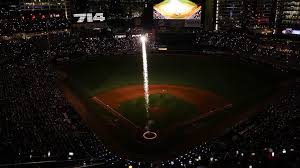 But this essay is not what happened 50 years ago in Atlanta. It's about what happened there last week. As mentioned, an elaborate display was concocted to celebrate Aaron’s historic moment. Part of that display was a melding of the two home run calls – Hamilton’s and Scully’s – blasting out as holograms of the ten players on the field in 1974 appeared on the suddenly dark canopy that team officials had created when they turned off every light in the park.
At first blush it was magnificent. The crowd saw Downing wind up and throw his first pitch, a curveball buried in the dirt at Aaron’s feet. The second pitch, however, was a letter-high fastball. Aaron swung. As he did, a round fireworks-style ball of sparkling light soared its way toward the left field wall as the sound of Hamilton’s call echoed throughout the park. That’s when the audio mash-up began and the two announcers’ calls became one – in essence, teaming up to form a single soundtrack of the recreation.
This is when, I suppose, it’s time to let you at least read a portion of Scully’s original call – the tail end of it – the part he delivered after Aaron had already rounded the bases and was now being mobbed at home plate by his friends, family, and teammates. Because that’s the part that framed not just the moment, but the context of that moment in history. As the celebration near home plate swelled and the crowd thundered its approval, Scully told the few hundred thousand Dodger fans within earshot of his voice:
A Black man is getting a standing ovation in the Deep South for breaking a record of an all-time baseball idol. What a marvelous moment for baseball. What a marvelous moment for Atlanta and the state of Georgia. What a marvelous moment for the country and the world.
It was the perfect description of what, because of all the hate mail that preceded it, can now be charitably described as a “nearly” perfect moment. Because Scully words were able to celebrate Hank Aaron's defining moment – even revel in it – while only hinting at the ugliness that made it a less-than-perfect moment in the annals of human history. Tears came to my eyes the first time I heard the call in its entirety, and truth be told I still find it hard to sit through Scully's full call without tearing up.
 Yet, in this day and age, when it seems more and more those in charge of the things we Americans hold dear don’t believe we're capable of both loving our country and, somehow, admitting (and learning from) its mistakes, some combination of the Braves and the commissioner's office did the unthinkable. They edited Vin Scully.
Seriously.
They deleted the first sentence of the above moment of play-by-play perfection – while keeping the three subsequent sentences intact. As a result, to listen to what was piped out into Atlanta’s Truist Park Tuesday night – and, by extension, millions of homes in America – one would think Scully’s “wonderful moment” referred to Aaron’s 715th home run, and only Aaron’s 715th home run.
It stripped his call, in other words, of almost every trace of poetry, grace, and historical context that he'd managed to instill into it as it passed over his lips a half century prior.
I sat there at my desk outraged, the moment being played out before me beneath a hail of fireworks and in front of thousands of screaming, cheering and even slightly delirious All Star attendees.
In a country – and, indeed, a world – increasingly divided along racial lines, Major League Baseball chose to perform elective surgery on a shimmering sliver of broadcasting perfection – a decision that, in the process, completely gutted Vin Scully's call of most of its power and glory. While, at the same time, those very same lords of the game deprived us – a deeply divided nation, especially the youngest and most impressionable among us – of the opportunity to relive the historical impact of the very moment they purported to want to celebrate.
I know, because I was there when that moment first unfolded. I saw its power to heal and its power to bind. I witnessed first-hand the almost magical way it had opened at least one heart, changed at least one mind, and, just maybe, pointed all of us in the direction of a more enlightened future.
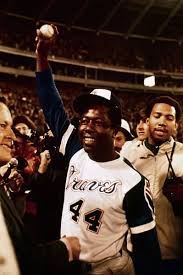 A half century ago, in other words, and in a relative blink of an eye, I witnessed an 19-year old Upstate New York schoolboy named Charlie – a kid who’d been taught to be a racist by God-knows-who – get transformed by one thing, and one thing only: a humble, gentle and softly aging Black man from South Alabama who, on an April night a full lifetime ago, dared to strive for greatness and dared to do something that no ballplayer had ever done before him. He swung his bat and swung it hard. And, in the process, he dared to try to change his country forever.
For the affront to history that was orchestrated at this past week’s All Star game, shame on the commissioner (I hate to admit, a fellow Central New Yorker).
And shame on Major League Baseball, too.
But, mostly, shame on the Atlanta Braves organization. Because, if anyone should have been aware of the full meaning – and I mean the full meaning – of the “wonderful moment” Henry Louis Aaron’s courage and lightning-quick wrists made possible (not to mention the magical way Vin Scully captured it for all time), it's them.